

What changed • Who it affects • Why it matters
Statewide Business Pulse
▲ Moving: North Dakota is entering the purchasing stage of its statewide Drone Replacement Program. The state finished technical and cost evaluations and is finalizing vendors, aircraft and pricing for NDAA-compliant drones. The Legislature appropriated $9 million for the replacement effort, creating a real procurement and supplier opportunity inside North Dakota’s growing UAS sector.
▬ Stable: North Dakota’s taxable sales and purchases totaled $7.39 billion in the second quarter, up 3.86% from the same period last year. That statewide number is useful as a baseline as higher fuel and borrowing costs begin working their way through business and household budgets.
▼ Down / Under Pressure: The diesel problem has deepened. U.S. diesel moved above $6 a gallon nationally last week, while North Dakota’s average reached a record $5.83 on September 11, up 68% from a year earlier. Now another Midwest supply problem has appeared: ExxonMobil’s 264,000-barrel-per-day Joliet, Illinois, refinery shut down Sunday after a power outage. The refinery can produce roughly 11 million gallons of fuel per day and serves Midwest gasoline and diesel markets.
Watch: I searched specifically for the reported two-week truckers’ strike. I still cannot verify a current nationwide U.S. trucking strike through the Teamsters, major freight reporting or credible national news sources. The searches repeatedly surface an unrelated two-week meatpacking strike from March and a California cement-truck strike that ended in August. Until there is a credible source, we will not report a nationwide trucker strike as fact. The freight and fuel risk surrounding that rumor, however, is very real.
Today’s Signals
1. Supply Chain / Fuel: The bigger risk isn’t a strike we can’t verify. It’s a diesel system already under strain.
What changed
The diesel story has moved beyond expensive fuel.
U.S. diesel exceeded $6 per gallon last week, compared with $3.71 a year earlier. Diesel inventories have been strained by disruptions to Middle Eastern and Russian supplies while U.S. refiners have been running hard to meet demand.
Another problem developed Sunday.
ExxonMobil temporarily shut its 264,000-barrel-per-day Joliet refinery in Illinois following a power outage. Reuters reports the refinery is capable of producing roughly 11 million gallons of gasoline and diesel per day and is an important supplier to Midwest markets.
Power was restored Sunday evening, and Exxon said it expected operations to normalize by the end of this week. That makes this a temporary disruption unless the restart takes longer than expected.
Meanwhile, global diesel markets remain exceptionally tight. Reuters reported this morning that Asian diesel refining margins have reached a record above $87 per barrel, while Russia is reportedly preparing to extend restrictions on diesel exports through October.
Who it affects
Trucking companies, independent drivers, farmers, contractors, manufacturers, wholesalers, grocery stores, retailers, delivery businesses and essentially every North Dakota company receiving products by truck.
Why it matters
North Dakota businesses shouldn’t wait for a trucker strike to recognize the supply-chain problem.
A truck still running at $6 diesel is not the same economic machine it was at $3.50 diesel.
The carrier either absorbs the cost, adds a fuel surcharge, raises the freight rate, rejects a marginal load or eventually leaves capacity sitting.
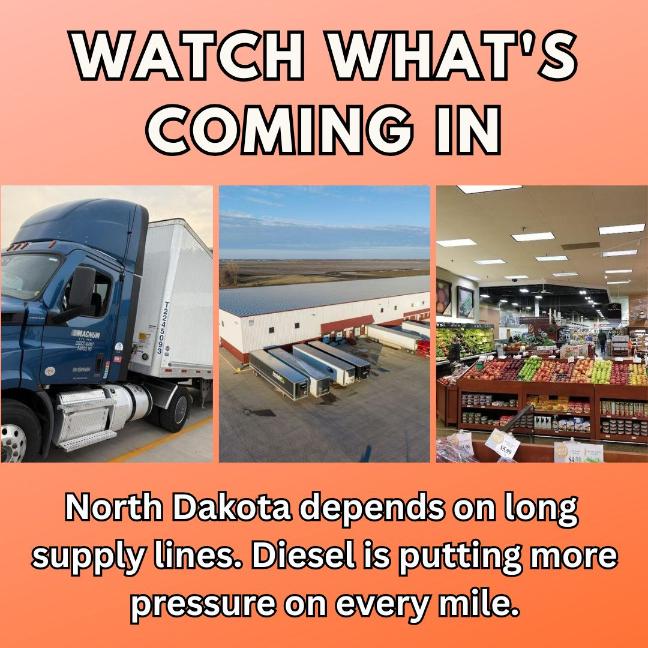
North Dakota is particularly exposed because of distance. Many products consumed here travel hundreds or thousands of miles before reaching a store, restaurant, construction site or manufacturer.
That means businesses should watch availability as well as price.
If diesel supply becomes tighter, the first problem may not be an empty fuel station. It could be a carrier becoming more selective about which loads are worth hauling.
Source links:
Reuters — Joliet refinery shutdown adds another Midwest fuel concern
Associated Press — Diesel above $6 strains transportation of everyday goods
Reuters — Global diesel market tightens further September 16
Reuters — Russia expected to extend diesel export restrictions
2. Grocery / Food Distribution: Fresh produce deserves special attention because North Dakota can’t stockpile it
What changed
High diesel costs are already increasing the cost of moving refrigerated food.
Associated Press reports that the diesel increase is feeding into grocery costs, particularly for perishable and refrigerated products.
The fresh-produce industry was warning about this before diesel reached current levels. Produce Business reported tighter refrigerated-trucking capacity and higher transportation costs this year, particularly for long-haul and short-notice loads.
That matters differently in North Dakota than it does near California, Arizona, Texas or Florida growing regions.
Who it affects
Grocery stores, restaurants, institutional food buyers, food distributors, schools, healthcare facilities and consumers — especially rural communities with fewer grocery suppliers.
Why it matters
A pallet of canned vegetables can sit in a warehouse.
Lettuce can’t.
Fresh produce has a narrow window between harvest and sale. If refrigerated freight becomes unavailable, too expensive or delayed, distributors have fewer options for rerouting product.
North Dakota also sits near the end of many fresh-food transportation routes. That means a disruption doesn’t have to originate here to appear on a North Dakota shelf.
I have not found reliable statewide evidence that North Dakota grocery stores are currently experiencing a broad produce shortage, so we should not make that claim based on scattered shelf conditions.
But reduced selection in individual stores would be consistent with the transportation pressures now affecting perishables.
For grocery and restaurant operators, the practical move is to talk with distributors now about fill rates, substitutions and expected freight surcharges rather than waiting for an item to disappear from an order.
Source links:
Associated Press — Diesel costs spread through food and freight
Produce Business — Refrigerated transportation faces tighter capacity and higher costs
3. Finance / Credit: Today’s Fed decision could make borrowing more expensive again
What changed
The Federal Reserve announces its interest-rate decision at 1 p.m. Central today.
Reuters reports markets overwhelmingly expect a quarter-point increase — what would be the Fed’s first rate hike since 2023.
The benchmark 10-year Treasury yield has already moved around the 5% level, reaching its highest level since 2007 this week.
Who it affects
Businesses using lines of credit, farmers with operating loans, commercial real-estate borrowers, companies financing vehicles or equipment and entrepreneurs trying to fund a startup or expansion.
Why it matters
We’ve discussed the Fed several times recently, so the new development today is simple: the guessing ends this afternoon.
If the Fed raises rates as expected, businesses with variable-rate debt may see borrowing costs move higher again.
But the statement following the meeting could matter more than today’s quarter point.
If policymakers indicate additional increases are likely, businesses should stop building fall and winter financing decisions around the assumption that cheaper money is right around the corner.
We’ll use the actual decision in tomorrow’s briefing rather than predict it here.
Source links:
Reuters — Federal Reserve decision due today
Reuters — Markets await Fed decision as Treasury yields hover near 5%
4. Technology / Procurement: North Dakota is about to start buying replacement drones
What changed
The North Dakota Department of Commerce announced Tuesday afternoon that the state’s Drone Replacement Program has reached the final procurement stage.
Technical and cost evaluations are complete.
The state is now finalizing:
- vendor selections;
- aircraft platforms; and
- pricing.
Purchases will replace state-agency drones that don’t meet federal National Defense Authorization Act requirements.
The Legislature previously appropriated $9 million for the program.
Who it affects
Drone manufacturers and vendors, UAS technology companies, software and sensor providers, trainers, maintenance businesses, state contractors and North Dakota companies working in the UAS supply chain.
Why it matters
This is different from another announcement about North Dakota being a drone leader.
The state is reaching the point where money gets spent.
Replacing aircraft also creates secondary business needs: sensors, software, training, maintenance, secure data systems and eventually replacement parts.
It also provides a test case for businesses using drones themselves.
Federal security requirements are increasingly affecting which technology government agencies can purchase. Companies doing government work should understand whether similar requirements could eventually reach the equipment they use on federal or state contracts.
Source links:
North Dakota Commerce — Drone Replacement Program reaches final procurement stage
Northern Plains UAS Test Site — North Dakota Drone Replacement Program
5. Small Business / Taxes: September 30 is the next North Dakota sales-tax deadline
What changed
With yesterday’s estimated-income-tax deadline behind us, the next state business-tax date worth putting on the calendar is September 30.
North Dakota monthly filers must submit August sales, use and gross-receipts tax returns and payments by that date.
Monthly restaurant and lodging returns and city motor-vehicle rental taxes for August are also due September 30.
Who it affects
Retailers, contractors and other businesses collecting sales tax, along with restaurants, lodging operators and vehicle-rental businesses that file monthly.
Why it matters
This isn’t a policy story. It’s a don’t-miss-the-date item.
The more useful reminder for contractors and businesses purchasing goods outside North Dakota is use tax.
North Dakota says businesses generally owe use tax when taxable equipment, building materials, shop supplies or other tangible property is brought or shipped into the state without the appropriate sales tax being collected by the seller.
Online purchasing makes that easier to overlook.
Source links:
North Dakota Tax Commissioner — 2026 sales and use tax deadlines
North Dakota Tax Commissioner — Sales and use tax guidance
Risk / Opportunity
Risk: The supply-chain problem deserves a wider lens than the rumored trucker strike. Diesel is already above $6 nationally, a major Midwest refinery is restarting after an unexpected shutdown, global diesel supplies remain tight and refrigerated freight is particularly sensitive to both price and capacity. A business doesn’t need fuel to become unavailable before this hurts. Higher freight charges, rejected loads, delayed deliveries and thinner grocery selection can arrive first.
Opportunity: Businesses that can source closer to home have a little more insulation from long-haul freight disruption. That doesn’t eliminate the fuel problem — local suppliers still use trucks — but shorter supply chains reduce the number of transportation links that can fail.
Watch: Truck availability, diesel availability and grocery fill rates. If credible evidence emerges of a coordinated trucking work stoppage, that changes the risk considerably. For now, I could not verify one, and NDBU should distinguish that rumor from the supply problems we can document.