

What changed • Who it affects • Why it matters
Statewide Business Pulse
▲ Moving: North Dakota lawmakers are heading into a September 2 special session, while data-center policy, industrial-development transparency and energy infrastructure remain active issues around the state.
▬ Stable: Business activity continues across sectors, but owners are operating against a backdrop of changing financing, supply-chain and energy conditions rather than a clear statewide acceleration or slowdown.
▼ Down / Under Pressure: Summit Carbon Solutions is abandoning two of its three planned North Dakota CO₂ storage areas, a significant reduction in the scope of a project that had been expected to drive construction, land, pipeline and related economic activity.
Watch: The First Brands automotive-parts liquidation, tomorrow’s special legislative session, data-center policy, September 7 PSC deadlines involving large electric loads and rate structures, and oil prices after a sharp geopolitical jump.
Today’s Signals
1. Automotive / Supply Chain: Major parts supplier moves from bankruptcy to liquidation
What changed
First Brands Group, once one of the largest automotive-aftermarket suppliers, has moved from Chapter 11 restructuring into Chapter 7 liquidation after a federal bankruptcy judge rejected its proposed restructuring plan.
The former First Brands portfolio included brands familiar to repair shops, parts stores, fleets and consumers, including CARDONE, Raybestos, Centric, FRAM, TRICO, ANCO, Autolite, StrongArm, Draw-Tite, Reese, Tekonsha, Hopkins and others.
The situation varies by brand. Some businesses were wound down, while assets and brand rights for others have already been sold to new owners. FRAM, TRICO, ANCO, Autolite, Luber-finer and StrongArm assets were acquired by Premium Guard; other brake and towing assets have also changed hands.
Who it affects
Independent repair shops, parts stores and distributors, dealerships, fleets, towing and trailer businesses, farms and construction companies maintaining vehicles and equipment, and consumers.
Why it matters
This is not simply a bankruptcy story. These brands occupy everyday replacement-part categories including brakes, filters, spark plugs, wipers, remanufactured components and towing equipment.
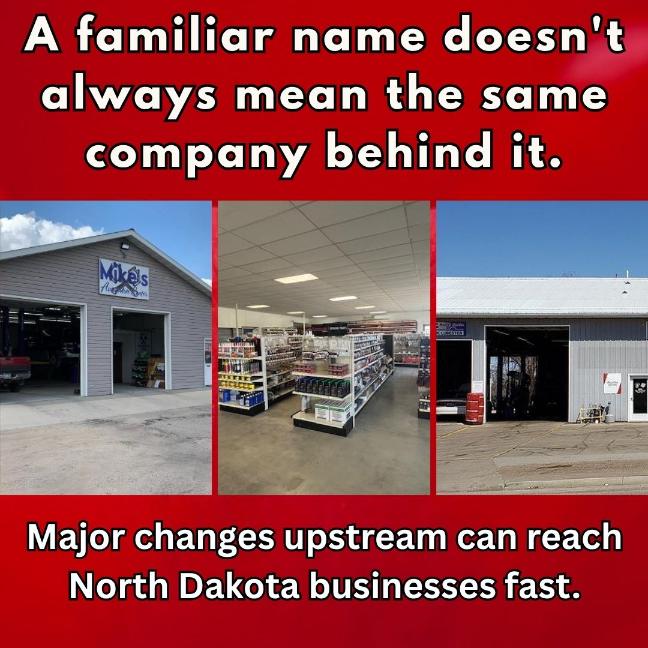
For businesses downstream, the issue is whether a familiar name still means the same manufacturer, distributor, warranty process, inventory availability or replacement part it did a year ago.
North Dakota businesses that rely heavily on affected lines may want to check open orders, warranty procedures, replacement SKUs and alternate suppliers before they have a vehicle or piece of equipment sitting idle waiting for a part.
Sources:
Reuters — First Brands bankruptcy and wind-down coverage
Premium Guard — acquisition of First Brands legacy brands and assets
Note: Bosch is not part of First Brands and should not be included in lists of affected brands.
2. Energy / Infrastructure: Summit drops two of three planned North Dakota CO₂ storage areas
What changed
Summit Carbon Solutions has told the North Dakota Supreme Court it will not proceed with two of its three proposed underground CO₂ storage facilities in the state.
The company asked that permits for Summit Storage Facilities No. 1 and No. 2 be canceled, saying it had decided as a matter of business judgment not to develop them. It continues its legal fight involving the third proposed storage area.
Who it affects
Landowners, contractors, pipeline and excavation companies, energy businesses, ethanol plants, local governments and communities that had expected construction or tax-base activity associated with the project.
Why it matters
This materially reduces the North Dakota footprint of one of the region’s largest proposed carbon-capture projects.
Businesses should distinguish between the broader Summit pipeline project and the specific North Dakota storage facilities being abandoned. The immediate economic effect is less potential construction and related spending around those two proposed storage areas, while the remaining project continues through litigation and permitting uncertainty.
Source:
North Dakota Monitor — Summit forfeits two CO₂ storage permits
3. Technology / Utilities / Local Government: Data-center debate is moving from recruitment to rules
What changed
North Dakota’s Artificial Intelligence and Data Center Committee spent August 31 hearing testimony on the costs and benefits of data centers, including concerns about electrical demand, water use, local decision-making and nondisclosure agreements.
Lawmakers are not taking up a statewide data-center moratorium during this week’s special session, but a proposal restricting nondisclosure agreements involving industrial developments remains part of the policy discussion.
Who it affects
Utilities, electric cooperatives, local governments, contractors, developers, landowners, manufacturers, large power users and businesses concerned about future utility costs or infrastructure capacity.
Why it matters
North Dakota’s discussion is changing. The question is no longer simply whether communities can attract data centers. Lawmakers and local officials are increasingly asking who pays for the power infrastructure, what communities are allowed to know during negotiations, and how these projects affect other customers.
That matters to businesses that may never operate a data center but still share the electric grid, workforce and construction market with them.
North Dakota is not alone. Reuters reported September 1 that utilities and regulators elsewhere are tightening requirements after discovering that some proposed data-center electricity demand may represent speculative or duplicate projects rather than firm development.
Sources:
North Dakota Legislative Branch — AI and Data Center Committee
North Dakota Monitor — August 31 data-center hearing
4. Legislature: North Dakota special session begins tomorrow
What changed
The North Dakota Legislature will convene in special session Wednesday, September 2.
Gov. Kelly Armstrong called the session primarily to establish a permanent statutory framework governing kratom and related products, but lawmakers have also advanced several additional measures for consideration.
A Special Ad Hoc Policy Committee meets today to take public input on bill drafts approved for introduction during the session.
Who it affects
Retailers and product sellers directly affected by kratom rules, along with businesses and communities affected by any additional policy measures taken up during the session.
Why it matters
Special sessions can move much faster than a regular legislative session. Business owners who may be affected should pay attention to the actual bill language and amendments, rather than assuming proposals discussed during interim meetings will emerge unchanged.
NDBU will continue separating what is proposed from what actually passes.
Source:
North Dakota Legislative Branch — September 2026 Special Session
5. Utilities / Development: September 7 deadlines could shape large-load electric service
What changed
The North Dakota Public Service Commission has several September 7 deadlines for parties seeking hearings in cases involving Montana-Dakota Utilities and Otter Tail Power.
Among them are MDU electric-service applications connected to large temporary loads and Otter Tail Power’s proposed Tiered Large General Service tariff.
Who it affects
Large industrial users, data-center developers, utilities, electric cooperatives, communities courting major projects and businesses concerned about how unusually large loads are priced and served.
Why it matters
This is the less-visible side of North Dakota’s data-center and industrial-development discussion.
Large projects don’t simply plug into the existing system. Utilities have to determine how much infrastructure is required, who pays for it and how the risk is handled if a proposed customer never uses the power it requested.
Those decisions can eventually influence rate design and infrastructure investment far beyond one project.
Source:
North Dakota PSC — meetings, hearings and filing deadlines
6. Energy / Operating Costs: Oil jumped sharply to start the week
What changed
Oil prices moved sharply higher Monday as escalating conflict in the Middle East raised concerns about global supply. Reuters reported West Texas Intermediate rising more than 3% during the session.
Who it affects
North Dakota oil producers and service companies, trucking and logistics firms, agriculture, construction, manufacturers and any business with significant fuel costs.
Why it matters
Higher crude prices can improve revenue for Bakken producers while creating the opposite effect for fuel-intensive businesses.
The important question is whether this is a short geopolitical spike or the beginning of a sustained increase. If prices remain elevated, diesel, freight and operating costs become the downstream issue for businesses outside the oil patch.
Source:
Reuters — oil rise and U.S. markets, August 31
Risk / Opportunity
Risk
The First Brands liquidation is a reminder that supply-chain disruption doesn’t always arrive as an empty shelf. A brand can remain available while ownership, production, warranties and distribution behind it have changed.
Large energy and data-center projects also continue to create uncertainty around infrastructure commitments, utility rates and local development expectations.
Opportunity
Businesses that check suppliers, alternate parts and contract dependencies before something fails have options. Those who wait until a truck, tractor or customer vehicle is sitting in the shop have considerably fewer.
North Dakota businesses also have an opportunity to pay attention while data-center and utility rules are still being written rather than after the cost structure is established.