

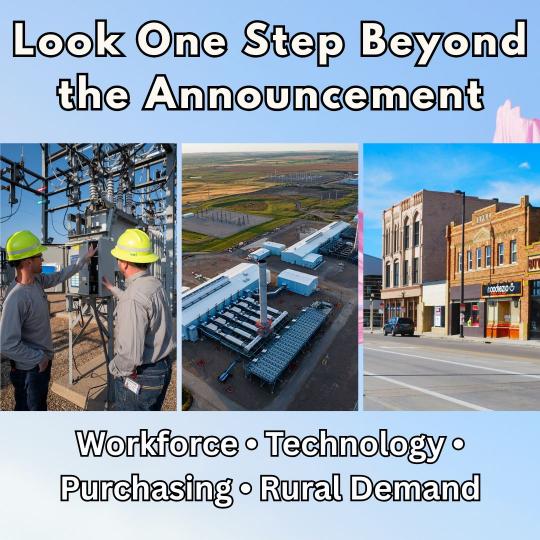
What changed • Who it affects • Why it matters
Statewide Business Pulse
▲ Moving: North Dakota employers still have several active workforce tools available. Commerce’s Technical Skills Training Grant is open with updated August guidance, while registration for the state’s Global Talent Summit closes Friday.
▬ Stable: U.S. industrial production grew only 0.1% in June, while manufacturing output was flat. July numbers arrive at 8:15 a.m. Central today, giving manufacturers, energy companies and suppliers a fresh read on demand and capacity.
▼ Down / Under Pressure: Rural employers continue running into workforce limits that money alone doesn’t solve. North Dakota’s current rural-health funding rounds are increasingly aimed at automation, transportation and staffing efficiency—evidence that access to workers remains an operating problem across smaller communities.
Watch: A rural-health technology grant closes at 5 p.m. today, another transportation grant closes Wednesday, and Global Talent Summit registration closes Friday. These are near-term deadlines with potential work for technology vendors, vehicle dealers, workforce partners and service providers—not only the organizations receiving the grants.
Today’s Signals
1. Technology / Rural Workforce: AI and automation funding deadline arrives today
What changed:
North Dakota HHS’s Technology as an Extender funding opportunity closes at 5 p.m. Central today, August 18. The program is designed to help eligible rural health facilities adopt smart technology, robotics and artificial intelligence. HHS says qualifying projects may automate routine clinical or administrative work, improve diagnostic accuracy, reduce workload on limited staff or improve care delivery.
Who it affects:
Rural hospitals, clinics, federally qualified health centers, skilled nursing and basic-care facilities directly—and technology companies, AI vendors, automation firms, integrators and consultants that may work with them.
Why it matters:
The business angle extends well beyond health care.
HHS specifically says award recipients may choose their own vendors and implementation or technology partners. That means rural-health funding can turn into private-sector work involving software, equipment, system integration, training and ongoing support.
It also gives other North Dakota employers something to watch. The state is funding technology specifically because organizations cannot simply hire their way out of workforce shortages. That same question applies in manufacturing, agriculture, accounting, retail and professional services: which repetitive tasks genuinely require another employee, and which could be handled differently?
Source link:
https://www.hhs.nd.gov/rural-health-transformation/funding
2. Rural Business / Procurement: $2 million vehicle opportunity closes Wednesday
What changed:
Applications for North Dakota’s Non-Emergency Medical Transportation Acquisition program close Wednesday, August 19 at 5 p.m. Central. HHS has approximately $2 million available and expects about four awards of roughly $500,000 each.
Funds can be used for new accessible vans and other passenger vehicles equipped to transport rural patients with mobility needs.
Who it affects:
Rural healthcare organizations directly, along with vehicle dealers, mobility-equipment companies, upfitters, service shops and transportation providers.
Why it matters:
This is a good example of why businesses should watch grants even when they aren’t eligible applicants.
A hospital receiving $500,000 may need vehicles, accessibility equipment, maintenance, insurance and operating services. The grant recipient gets the award; other businesses may get the work.
Businesses that sell or service accessible vehicles should be watching who receives these awards and whether future rural-health funding creates similar purchasing opportunities.
3. Workforce / Skilled Trades: State training grant remains open under updated August rules
What changed:
North Dakota Commerce updated guidance for its Technical Skills Training Grant on August 4. The program remains available to businesses, training providers, colleges, nonprofits, municipalities and trades organizations for rapid non-degree workforce training.
Three tracks are available:
- Up to $200,000 for new or expanded accelerated training programs.
- Up to $100,000 for companies training existing workers, including onboarding and safety training.
- Up to $200,000 for workforce training tied to automation, plus up to $100,000 for qualifying automation feasibility studies.
All tracks require a 1:1 match.
Who it affects:
Manufacturers, contractors, trades employers, healthcare employers, training providers and businesses having difficulty finding workers with the skills they need.
Why it matters:
North Dakota employers sometimes treat training as something that happens before a worker arrives. This grant recognizes that employers may need to build the worker they need after hiring.
Track C is especially worth noting. It supports training connected with automation rather than simply paying for machinery. For employers considering automation, the expensive piece isn’t always the equipment; employees still have to understand how to operate, maintain and use it effectively.
Source link:
https://www.commerce.nd.gov/workforce/workforce-programs/technical-skills-training-grant
4. Workforce: Global Talent Summit registration closes Friday
What changed:
Registration for North Dakota’s 2026 Global Talent Summit closes Friday, August 21 at 5 p.m. The summit will be held September 3 at Bismarck State College.
The program is aimed at employers and workforce organizations interested in recruiting, hiring and retaining international workers through legal employment pathways.
Who it affects:
Employers with persistent workforce shortages, particularly those recruiting skilled trades, technical workers, healthcare employees and other difficult-to-fill positions.
Why it matters:
North Dakota employers already know there isn’t one workforce solution.
Some businesses can automate. Some can train existing workers. Some need childcare or housing solutions. Others may need to recruit people who simply aren’t currently available in their local labor market.
For employers considering international recruitment, the value here is practical information about legal hiring pathways and retention, rather than trying to piece the process together after finding a candidate.
Source links:
https://www.commerce.nd.gov/workforce/global-talent-office/global-talent-summit
5. Manufacturing / Energy: Fresh industrial-production numbers arrive this morning
What changed:
The Federal Reserve releases July Industrial Production and Capacity Utilization at 8:15 a.m. Central today. The most recent report showed total industrial production increasing just 0.1% in June, while manufacturing output was unchanged. Mining output increased 0.4%.
Manufacturing capacity utilization stood at 75.7% in June, below its long-run average, while mining utilization was above its long-run average.
Who it affects:
North Dakota manufacturers, machinery and equipment suppliers, energy companies, contractors, freight businesses and companies selling into industrial supply chains.
Why it matters:
This is one of the better national reports for separating what is happening in factories, mining and utilities.
For North Dakota, the mining and manufacturing pieces deserve separate attention. Strong energy production can coexist with softer factory demand, so a single economic headline can hide very different conditions for businesses operating in different industries.
Owners selling equipment, materials or industrial services should compare this morning’s July results with what they are seeing in quotes, orders and customer backlogs.
Source links:
https://www.federalreserve.gov/releases/g17/
https://www.federalreserve.gov/releases/g17/current/default.htm
6. Seasonal Commerce: Deer archery season starts September 4
What changed:
North Dakota Game and Fish announced Monday that deer archery season opens September 4 at noon and runs through January 3. Nonresident bowhunters cannot use most public land during the first 9½ days of the season; public-land access begins September 14.
Game and Fish also reminded hunters that bow tags are mailed and must be physically in hand before hunting.
Who it affects:
Sporting-goods stores, archery shops, outfitters, rural lodging, restaurants, fuel retailers, meat processors and small businesses serving hunters.
Why it matters:
Hunting seasons create a predictable burst of spending across many smaller North Dakota communities.
Businesses serving hunters have roughly two weeks to make sure inventory, hours, reservations and local information are ready. The nonresident public-land restriction may also affect where early-season visitors travel and spend money.
This is seasonal rather than statewide economic policy, but the spending is distributed across rural communities that don’t always benefit from the state’s larger events.
Source link:
https://gf.nd.gov/news/9561
Risk / Opportunity
Risk:
Workforce shortages are increasingly forcing employers to solve several problems at once: recruiting, training, transportation and productivity. The current state programs make that clear. Businesses that continue treating every staffing problem as simply “we need to find another person” may be limiting their options.
Opportunity:
A significant amount of public funding is moving through organizations that will eventually need private businesses to supply the work. Technology, vehicles, workforce training and implementation services are all examples. Businesses don’t always need to qualify for the grant to benefit from the spending it creates.
The useful question is becoming: Who received the money—and what will they need to buy next?