

What changed • Who it affects • Why it matters
Statewide Business Pulse
▲ Moving: North Dakota’s Big Iron week begins today with the North Dakota Trade Office’s International Visitors Program. International guests will spend the week touring farms and businesses, attending equipment demonstrations and meeting North Dakota companies. For agricultural manufacturers and technology companies, this is a direct export-development opportunity rather than simply another farm show.
▬ Stable: North Dakota drilling activity held at 34 active rigs Sunday, one below the prior week but two above a month earlier. That suggests the recent increase in Bakken activity hasn’t disappeared, though it hasn’t accelerated further either.
▼ Down / Under Pressure: A new national report released today has particular relevance to North Dakota agriculture: average rail fuel surcharges on grain shipments have climbed 153% from a year ago, reaching 48 cents per rail-car mile. USDA data show those surcharges now represent 11% of total rail transportation costs for corn and soybeans, up from 5% a year ago.
Watch: The Federal Reserve begins its two-day meeting Tuesday. Friday’s Consumer Price Index showed prices rising 0.4% in August and 3.4% over the past year, with gasoline accounting for more than one-third of the monthly increase. The Fed announces its rate decision Wednesday afternoon.
Today’s Signals
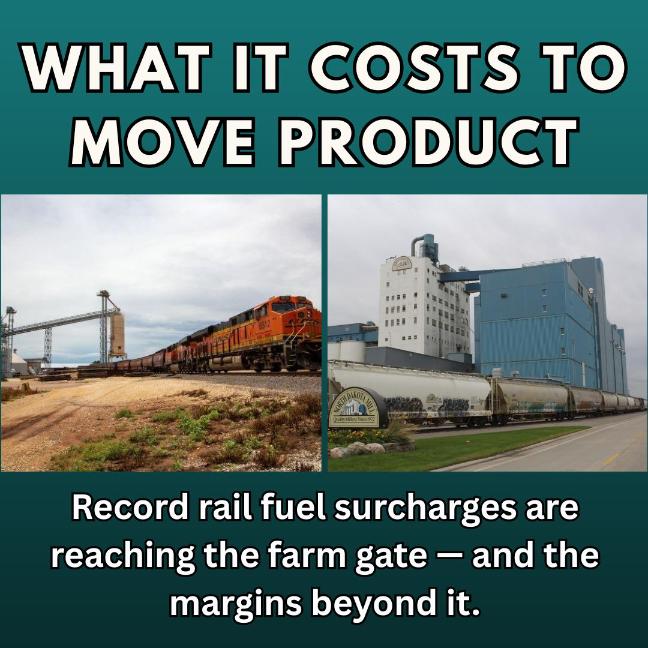
1. Agriculture / Transportation: Record rail fuel surcharges are reaching the farm gate
What changed
Reuters reported this morning that railroad fuel surcharges on U.S. grain shipments have reached record levels.
USDA data show the average surcharge reached 48 cents per rail-car mile during the second week of September, up 153% from a year earlier.
Surcharges now account for about 11% of rail transportation costs for corn and soybeans, compared with 5% a year ago.
North Dakota State University crop economist Frayne Olson told Reuters that the speed of the fuel-price increase is creating significant problems for an industry where margins can come down to only a few cents per bushel.
Who it affects
Farmers, grain elevators, cooperatives, processors, agricultural lenders, exporters, rail-dependent manufacturers and rural businesses whose communities depend on farm income.
Why it matters
For North Dakota, rail freight isn’t an abstract transportation cost.
A large share of the state’s grain must travel long distances by rail before reaching processors or export markets. When freight costs rise, elevators can account for those costs through the basis they offer producers — the difference between the futures price and the local cash price.
That means a farmer doesn’t necessarily receive a separate bill marked “rail fuel surcharge.” The cost can appear as a lower price for the crop.
The pressure also arrives during harvest, when grain movement is increasing and producers are already dealing with higher fuel and production costs.
For businesses in farm communities, this is worth watching because weaker farm margins eventually affect equipment purchases, repairs, borrowing and Main Street spending.
Source links:
Reuters — Rail fuel surcharges on grain reach record highs
2. Credit / Finance: Friday’s inflation report leaves the Fed with an uncomfortable choice
What changed
The Bureau of Labor Statistics reported Friday that consumer prices rose 0.4% in August, following a 0.1% increase in July.
Prices were 3.4% higher than a year earlier.
Gasoline rose 3.9% during August and accounted for more than one-third of the monthly increase. Energy overall increased 2.1%.
Core inflation — excluding food and energy — rose 0.3% during the month and 2.4% over the year.
The Federal Open Market Committee begins its two-day meeting Tuesday and announces its interest-rate decision Wednesday at 1 p.m. Central.
Who it affects
Businesses with variable-rate debt, farmers using operating loans, commercial borrowers, companies considering equipment financing, entrepreneurs seeking capital and consumers financing major purchases.
Why it matters
The inflation report didn’t give the Federal Reserve an obvious reason to declare victory.
Core inflation is considerably closer to the Fed’s target than headline inflation, but energy costs are pushing the overall number higher again.
For business owners, the bigger lesson is that lower borrowing costs still aren’t guaranteed.
An equipment purchase, refinance or expansion that only works if interest rates decline soon probably deserves another look.
Wednesday’s decision matters, but the Fed’s explanation may matter just as much. Owners should listen for whether policymakers see the current energy-driven inflation as temporary or as something requiring tighter credit for longer.
Source links:
U.S. Bureau of Labor Statistics — August 2026 Consumer Price Index
Federal Reserve — September 15–16 FOMC meeting schedule
3. Taxes: A North Dakota estimated-tax deadline arrives Tuesday
What changed
September 15 is the deadline for several North Dakota income-tax obligations.
For calendar-year corporations, the third-quarter 2026 estimated corporate income-tax payment is due Tuesday.
September 15 is also the third-quarter estimated income-tax deadline for individuals who make estimated payments, which can include sole proprietors and other business owners whose income isn’t fully covered by withholding.
North Dakota cooperatives with calendar-year reporting also have a Form 40 filing and payment deadline September 15.
Who it affects
Corporations, cooperatives, sole proprietors and other business owners who make North Dakota estimated income-tax payments.
Why it matters
This is a calendar item, but it passes the briefing test because missing it can cost money.
Owners with variable income should also make sure the amount they’re paying still makes sense based on how the business has actually performed this year.
A business that had a stronger or weaker year than expected may need to revisit estimated payments rather than automatically sending the same amount used earlier in the year.
Businesses unsure what applies to them should check with their accountant or tax preparer rather than assume every business shares the same September 15 requirement.
Source links:
North Dakota Tax Commissioner — Corporate income-tax deadlines
North Dakota Tax Commissioner — Individual estimated-tax deadlines
4. Agribusiness / Manufacturing: Big Iron week is also an export-sales week
What changed
The North Dakota Trade Office’s 2026 Big Iron International Visitors Program begins today and runs through Thursday.
International participants will attend farm and ranch tours, equipment demonstrations, educational programs, business receptions and the Big Iron Farm Show in West Fargo.
The Trade Office uses the program to connect foreign buyers and agricultural professionals with North Dakota companies.
Last year’s program brought roughly 40 visitors from five countries to North Dakota and included visits to companies such as Titan Machinery, RDO Equipment, Amity Technology and Crary-related operations.
Who it affects
Agricultural manufacturers, equipment companies, precision-ag businesses, technology providers, exporters, suppliers and North Dakota companies trying to develop international customers.
Why it matters
Big Iron tends to be viewed primarily as a farm show.
For North Dakota businesses, the international program is a different opportunity.
Potential buyers are coming here to see equipment and technology operating in the environment where it was developed. That gives North Dakota manufacturers and technology companies something harder to replicate through an online sales pitch.
It also matters beyond large equipment manufacturers. Smaller companies supplying components, technology, software or specialty agricultural products can benefit from the relationships created around larger trade events.
Source links:
North Dakota Trade Office — 2026 Big Iron International Visitors Program
North Dakota Trade Office — 2025 International Visitors Program recap
5. Energy / Technology: Another possible data-center development emerges west of Fargo
What changed
Geronimo Power confirmed late last week that it is exploring a possible data center in Harmony Township west of Fargo, near its Harmony Solar project.
No data-center application has been submitted and the size of any potential facility has not been announced.
What is further along is the accompanying energy infrastructure.
Harmony Solar is a 200-megawatt project now under construction. Geronimo also proposes a 200-megawatt battery-storage facility capable of storing electricity for up to four hours.
The Public Service Commission has scheduled an October 23 public hearing in Casselton on the $249 million storage project.
Who it affects
Utilities, electrical contractors, construction companies, landowners, local governments, data-center developers, technology companies and businesses concerned about future grid capacity and electricity costs.
Why it matters
This deserves attention without treating an early proposal as a finished project.
North Dakota’s data-center discussion is increasingly becoming an energy-infrastructure discussion.
Large computing facilities require substantial and dependable power. That creates demand for generation, transmission, substations and storage — along with questions about who pays for those investments and whether other customers benefit or absorb additional costs.
The Harmony proposal is particularly worth watching because the energy projects are moving ahead even though the possible data center remains preliminary.
The October battery-storage hearing should provide businesses and residents with more detail about one piece of that infrastructure.
Source links:
North Dakota Monitor — Geronimo Power explores data center west of Fargo
Valley News Live — Geronimo confirms early Cass County discussions
Risk / Opportunity
Risk: Transportation costs are becoming another margin problem for agriculture. Today’s rail-surcharge report is important because the expense can be hidden inside the local grain price rather than appearing as an obvious new bill. With diesel costs already elevated, farmers and businesses serving them should watch basis levels and freight costs closely this fall.
Opportunity: Big Iron week puts North Dakota agricultural equipment and technology businesses directly in front of international visitors. Companies that think of the event only as a domestic farm show may be overlooking its export-development side.
Watch: Wednesday’s Federal Reserve decision will answer the immediate rate question. The bigger business signal will be what policymakers say about the path ahead after August inflation remained at 3.4% and energy costs increased sharply.