

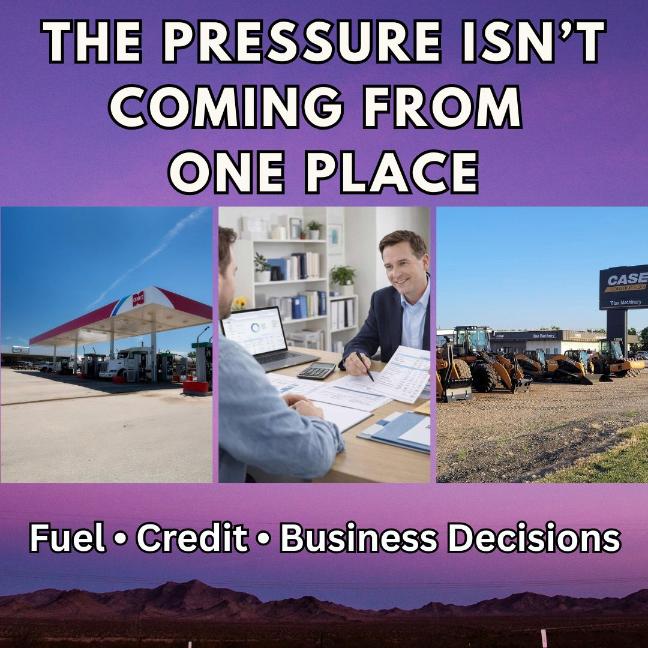
What changed • Who it affects • Why it matters
Statewide Business Pulse
▲ Moving: North Dakota’s LIFT Committee meets today to review the latest applications for low-interest financing aimed at technology, advanced manufacturing, energy, value-added agriculture and other businesses that diversify the state’s economy. The next application window opens October 5.
▬ Stable: Small-business owners have a new chance to put North Dakota’s experience into a national data set. The Federal Reserve’s 2026 Small Business Credit Survey opens today, gathering information about financing, business performance and credit conditions.
▼ Down / Under Pressure: Energy costs are again moving quickly. Brent crude climbed above $100 per barrel this morning amid disruption to oil shipments through the Strait of Hormuz. U.S. diesel reached a record $5.94 per gallon, according to AP. For North Dakota, that’s a split signal: stronger oil economics for producers and service companies, but higher fuel and freight costs for agriculture, trucking, construction and Main Street businesses.
Watch: Borrowing costs remain unsettled. A Reuters poll released today finds most economists expect the Federal Reserve to hold rates at 3.50%–3.75% next week and through year-end, but a growing number now expect another increase. Friday’s inflation report could change that calculation.
Today’s Signals
1. Energy / Transportation: $100 oil cuts two ways in North Dakota
What changed
Brent crude moved back above $100 per barrel Wednesday morning as escalating U.S.-Iran conflict continued to disrupt oil movements through the Strait of Hormuz.
U.S. crude reached about $95 per barrel, while gasoline and diesel prices have also climbed. Diesel reached a record $5.94 per gallon.
Who it affects
Bakken producers and oilfield-service companies, farmers and ranchers, trucking and delivery companies, contractors, manufacturers, retailers and virtually any business paying freight charges.
Why it matters
North Dakota experiences high oil prices from both sides.
Higher crude prices can improve drilling economics, strengthen oilfield activity and support businesses serving western North Dakota.
But diesel is an operating expense across the rest of the state.
Harvest equipment burns it. Trucks burn it. Contractors burn it. And businesses that don’t purchase diesel directly can still pay for it through freight and supplier surcharges.
That makes today’s energy move considerably broader than an oil-industry story.
Businesses with significant fuel exposure should revisit estimates built into fall jobs, deliveries and operating budgets rather than assuming the fuel price used when the work was quoted still holds.
Source link:
Associated Press — oil moves above $100 as Middle East conflict disrupts supply
2. Credit / Finance: The question isn’t just when rates fall anymore
What changed
A Reuters survey of economists released today finds a majority expect the Federal Reserve to leave its benchmark interest rate at 3.50%–3.75% at its September 15–16 meeting and keep it there through the end of 2026.
But confidence in that forecast is weakening.
More economists now expect at least one additional rate increase this year as stronger economic data and persistent inflation complicate the outlook. Financial markets are also pricing in the possibility of higher rates.
Friday’s Consumer Price Index will be an important piece of the Fed’s decision.
Who it affects
Businesses with variable-rate debt, farmers using operating credit, companies financing equipment or real estate, entrepreneurs seeking startup capital and owners considering refinancing.
Why it matters
For much of the year, the financing question has been how soon borrowing gets cheaper.
Businesses shouldn’t assume that’s still the only possible direction.
No rate increase has been decided. But an owner postponing an equipment purchase solely because rates are expected to fall may want to run the numbers under more than one scenario:
- rates decline;
- rates stay where they are; or
- rates rise again.
The right purchase can still make sense at today’s rate. The important part is not building the decision around a rate cut that may never arrive.
Source link:
Reuters — September 9 Federal Reserve economist survey
3. Small Business / Credit: North Dakota owners can help show lenders what is actually happening here
What changed
The Federal Reserve’s 2026 Small Business Credit Survey opens today.
The annual survey asks small-business owners about revenue, employment, financing needs, credit applications and the financial challenges they are experiencing. Results are used to produce national and regional reports on small-business credit conditions.
Last year’s survey collected responses from 6,525 employer firms across all 50 states and Washington, D.C.
Who it affects
Small employers, sole proprietors, entrepreneurs, lenders, economic-development organizations and policymakers trying to understand small-business financing.
Why it matters
North Dakota can disappear inside national business statistics simply because its population is small.
This survey is one place owners can put actual business experience into the data used to describe access to credit.
That’s particularly useful now.
Yesterday’s NFIB report showed weaker small-business sales and persistent inflation concerns. Today’s Federal Reserve survey provides another way to measure whether owners are getting the financing they need—and what happens when they don’t.
For NDBU, the eventual results are also worth keeping as a benchmark against what North Dakota owners tell us directly.
Source links:
Federal Reserve Small Business Credit Survey — 2026 survey information
Federal Reserve — previous Small Business Credit Survey findings
4. Entrepreneurs / Technology: North Dakota decides where its next round of innovation financing goes today
What changed
The LIFT Committee meets today to review applications submitted during North Dakota’s latest Legacy Investment for Technology Loan Fund round.
LIFT provides low-interest debt financing to qualifying businesses developing or commercializing technology in areas including:
- advanced computing and data management;
- agricultural technology;
- autonomous systems;
- energy;
- health care;
- value-added agriculture; and
- value-added energy.
Businesses that missed the current round aren’t shut out for long.
The next application period opens October 5 and closes November 9, with funding review scheduled for January 13.
Who it affects
Startups, manufacturers, technology companies, inventors and established North Dakota businesses developing new products or commercial applications.
Why it matters
This isn’t a general-purpose business loan, and that’s precisely why it can be useful.
Companies developing something new often reach a financing gap where the product is beyond the idea stage but doesn’t yet have enough operating history for conventional financing.
LIFT is designed partly for that space.
Owners considering the October round have almost a month to determine whether their project fits before applications open. That’s more useful than finding the program a week before applications close.
Source link:
North Dakota Commerce — Legacy Investment for Technology Loan Fund
5. Small Business / Entrepreneurship: A statewide resource reaches 40 years—and its services remain free to owners
What changed
The North Dakota Small Business Development Centers marked their 40th anniversary this year, with a new statewide overview published Tuesday.
Since 1986, the network reports helping launch more than 4,300 businesses and create or retain more than 88,000 jobs.
More useful to an owner today: ND SBDC continues to provide no-cost, confidential advising to entrepreneurs and existing businesses, including owners working through growth, financing, management or succession decisions.
Who it affects
Entrepreneurs, existing small-business owners, family businesses considering transition, businesses seeking financing and owners who need outside help working through a decision but aren’t ready to hire a consultant.
Why it matters
This clears the relevance filter because it addresses a problem we’ve seen repeatedly: North Dakota often already has a resource for a business problem, but owners don’t necessarily know it exists—or assume it’s only for startups.
SBDC isn’t only a startup program.
An existing owner can use it to work through financing, expansion, business planning or transition issues confidentially without adding another professional-services bill.
That’s worth knowing when margins are already under pressure.
Source link:
UND — North Dakota SBDC statewide small-business services
Risk / Opportunity
Risk: The combination of record diesel prices and uncertainty over interest rates can hit a business twice: once through daily operating expenses and again when it needs to finance equipment, inventory or expansion. Neither cost should be treated as temporary when building a fall budget.
Opportunity: Today’s LIFT review and the opening of the Federal Reserve credit survey represent two very different ways North Dakota businesses can influence what happens next—one through access to state financing and the other by making sure small-state business conditions are represented in national credit data.
Watch: Friday’s inflation report now carries additional weight. A hotter reading, combined with rising energy costs and strong recent employment data, could strengthen the argument for higher interest rates rather than the lower rates many businesses have been waiting for.