

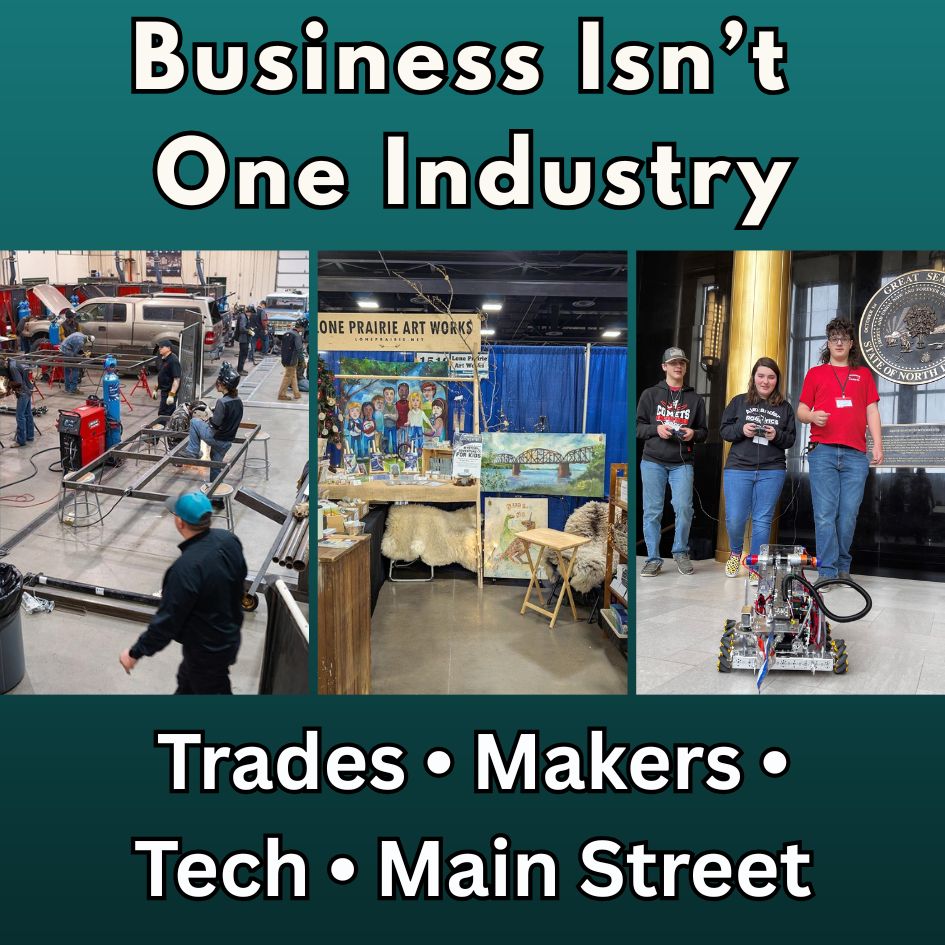
What changed • Who it affects • Why it matters
Statewide Business Pulse
▲ Moving: AI/data-center policy, workforce training, small-business financing, maker/food-product sales, trades education
▬ Stable: Statewide hiring demand, rural business support, construction procurement, Main Street service demand
▼ Down / Under Pressure: Employers competing for skilled labor, businesses facing month-end filing pressure, repair- and fuel-dependent operators
Watch: Today’s AI/Data Center Committee, July 17 NDDOT bid opening, July 20 Ellendale utility hearing-request deadline, July 30 LIFT deadline, July 31 tax and withholding deadlines
Today’s Signals
1. State Policy / Land Use: AI and data-center committee meets today
What changed:
The Legislature’s Artificial Intelligence and Data Center Committee meets today, July 15, from 9:00 a.m. to 4:00 p.m. Central at the State Capitol. The agenda includes AI regulation, model ordinances, state agency AI use, and the relationship between data-center growth and the energy sector.
Who it affects:
Landowners, counties, cities, utilities, electric co-ops, contractors, developers, insurers, lenders, manufacturers, technology firms, and rural businesses.
Why it matters:
This is where technology policy turns into business policy. Data centers can affect land use, power demand, water use, transmission planning, local services, tax incentives, construction demand, and future utility costs.
Source links:
https://ndlegis.gov/events/2026/07/15/artificial-intelligence-and-data-center-committee
https://ndlegis.gov/assembly/69-2025/interim/27-5168-02000-meeting-agenda.pdf
https://video.ndlegis.gov/
2. Trades / Education: BSC is using XR and robotics to expose educators to Industry 4.0 skills
What changed:
Bismarck State College’s XR for VR program lists a four-day CTE Educators Workshop focused on robotics, drones, programmable logic controllers, automation systems, assistive technology, and virtual reality. The program is designed to help K–16 educators connect classroom learning with current workforce pathways.
Who it affects:
Employers needing skilled workers, CTE teachers, students, manufacturers, energy companies, automation firms, assistive-technology users, and workforce partners.
Why it matters:
North Dakota’s skilled-labor problem starts before the hiring stage. When educators better understand automation, robotics, energy systems, and advanced manufacturing, students are more likely to see trades and technical careers as real options.
Source links:
https://bismarckstate.edu/academics/xrforvr/events/
https://bismarckstate.edu/
3. Entrepreneurs / Financing: LIFT remains open for technology commercialization
What changed:
Commerce says LIFT Program applications are open through July 30, 2026. The program supports North Dakota companies commercializing technology and has recommended $47.5 million through 76 awards since inception. Terms include 0% interest for the first three years and 2% during years four and five.
Who it affects:
Startups, ag-tech firms, advanced computing companies, energy innovators, autonomous-systems businesses, health care technology companies, value-added agriculture companies, lenders, and economic developers.
Why it matters:
This is a financing option for companies trying to move a product, process, or technology from development into the market. In a higher-cost borrowing environment, below-market loan terms can matter.
Source links:
https://www.commerce.nd.gov/news/lift-program-now-accepting-applications-through-july-30-2026
https://belegendary.link/LIFT
4. Makers / Food Businesses: Pride of Dakota Marketplace gives local products a statewide sales window
What changed:
The North Dakota Department of Agriculture lists the Pride of Dakota Marketplace at the North Dakota State Fair, July 17–25. Pride of Dakota also supports North Dakota-made products through promotion, retail exposure, and member visibility.
Who it affects:
Food producers, artisans, makers, specialty retailers, packaging suppliers, small manufacturers, farm-based businesses, and entrepreneurs testing products with a larger audience.
Why it matters:
Events like this are not just booth-sales opportunities. They help small producers test pricing, packaging, customer reaction, wholesale potential, online follow-up, and whether a product is ready for wider distribution.
Source links:
https://www.ndda.nd.gov/news/2026-pride-dakota-showcase-dates-released-pride-dakota-marketplace-2026-state-fair-announced
https://www.prideofdakota.nd.gov/
5. Small Business Access: Dakota BOT may reduce time spent hunting for state information
What changed:
Commerce and NDIT launched Dakota BOT, an AI-powered chatbot meant to help citizens, businesses, and visitors access information across ND.gov and affiliated state agency websites. Commerce says the tool is designed to improve access to state services.
Who it affects:
Business owners, permit seekers, employers, startups, rural communities, tourism operators, contractors, and anyone trying to find state forms, contacts, or program information.
Why it matters:
Small businesses lose time when basic government information is hard to find. Dakota BOT does not replace agency confirmation, but it could become a useful first stop for finding forms, programs, deadlines, and contacts.
Source link:
https://www.commerce.nd.gov/news/north-dakota-launches-dakota-bot-modernize-public-access-state-services
6. Workforce: Job Service has youth and hiring events in motion
What changed:
Job Service North Dakota lists an Adulting Challenge today in Grand Forks, an Altru hiring event on July 17, a Real. Good. Northeast North Dakota Virtual Job Fair on July 23, and Talent Tuesday in Fargo on July 28.
Who it affects:
Employers, HR managers, health care providers, retailers, restaurants, service businesses, job seekers, students, and regional workforce partners.
Why it matters:
This is a reminder that workforce development is not only about immediate job openings. Employers need both near-term recruiting and longer-term worker readiness, especially in regions where applicant pools remain thin.
Source links:
https://www.jobsnd.com/events
https://www.jobsnd.com/events/real-good-northeast-north-dakota-virtual-job-fair
https://www.jobsnd.com/events/talent-tuesday-hiring-event-fargo-0
7. Business Law: Court ruling matters for companies working across state lines
What changed:
The North Dakota Supreme Court issued an opinion stating that registering to do business in North Dakota, by itself, is not enough contact for jurisdiction over a foreign corporation.
Who it affects:
North Dakota businesses contracting with out-of-state companies, foreign corporations registered in North Dakota, suppliers, contractors, lenders, insurers, and attorneys.
Why it matters:
Business registration does not automatically answer where a dispute can be heard. Contracts with out-of-state parties should clearly address venue, governing law, dispute resolution, and where work is actually being performed.
Source links:
https://www.ndcourts.gov/news/north-dakota/north-dakota-supreme-court/opinions/new-opinions-july-9-2026
https://www.ndcourts.gov/supreme-court/opinions/20260052
8. Tax / Employer Compliance: July 31 has several filing deadlines stacked together
What changed:
The Tax Commissioner lists July 31 deadlines for monthly, quarterly, and semiannual sales and use tax filings, restaurant and lodging taxes, city motor vehicle rental taxes, and quarterly income tax withholding.
Who it affects:
Retailers, restaurants, hotels, contractors, rental businesses, employers with payroll, bookkeepers, accountants, and nonprofits.
Why it matters:
This is a back-office pinch point. Businesses should reconcile now rather than waiting until the final week, especially if they file more than one type of return.
Source links:
https://www.tax.nd.gov/sales-and-use-tax-deadlines
https://www.tax.nd.gov/income-tax-withholding-deadlines
Risk / Opportunity
Risk:
The near-term risk is scattered pressure: policy decisions on AI and data centers, tight labor supply, legal uncertainty in multistate contracts, small-business compliance deadlines, and the ongoing need to train workers before vacancies become emergencies.
Opportunity:
The opportunity is broader than ag and energy today. Entrepreneurs have financing options, makers and food businesses have a statewide sales window, educators are being exposed to technical career tools, and businesses can use state and workforce resources before costs or deadlines land on them.