

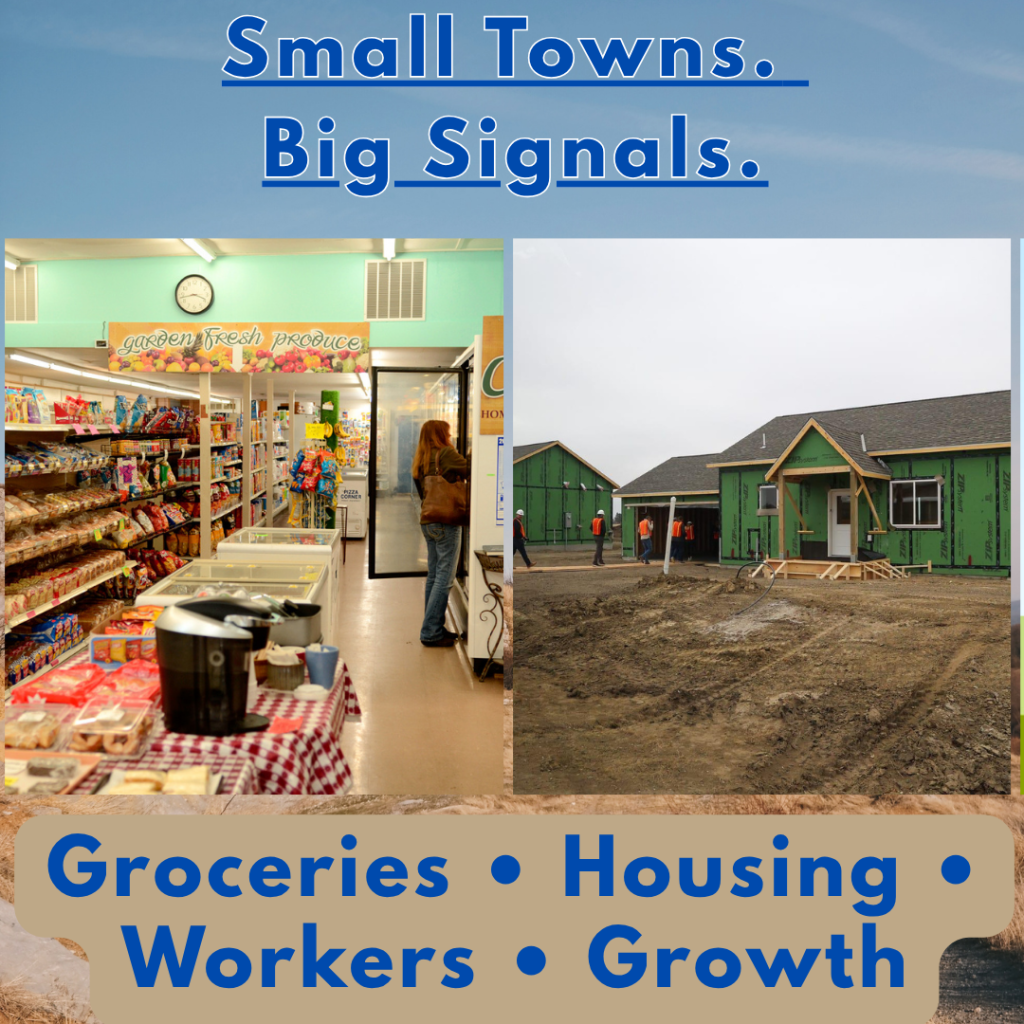
What changed • Who it affects • Why it matters
Statewide Business Pulse
▲ Moving: Rural housing, healthcare/education jobs, tourism investment, rural business financing, workforce partnerships
▬ Stable: Professional services, essential retail, local service businesses
▼ Down / Under Pressure: Rural grocery access, manufacturing, retail trade, mining, financial activities
Watch: Small-town business survival, workforce housing, slower job growth, startup caution, global investment follow-through
Today’s Signals
Rural Retail / Groceries: Small-town grocery survival is now an economic development issue
What changed: North Dakota is putting attention and money toward rural grocery sustainability. The state’s Rural Grocery Store Sustainability Grant is aimed at food access, economic development, and keeping rural communities viable. Commerce’s grant page says the program is intended to address challenges rural communities face with food access, sustainability, and economic development.
Who it affects: Rural grocery stores, cafés, hardware stores, pharmacies, elderly residents, local employers, school families, farmers, and small-town economic developers.
Why it matters: When a rural town loses a grocery store, it loses more than food access. It loses daily foot traffic, local spending, convenience for workers, and one more reason families choose to stay.
Source: North Dakota Commerce — Rural Grocery Store Sustainability Grant:
https://www.commerce.nd.gov/community-services/community-development-rural-prosperity/cdrp-resources/cdrp-grant-programs/rural
Workforce / Economic Forecast: North Dakota job growth is slowing
What changed: A legislative economic forecasting report projects North Dakota employment growth easing to 0.6% in 2026. It also says education/health and government are expected to be the top job creators, while weakness in trade/transportation and mining will hold back overall growth.
Who it affects: Employers planning to expand, retailers, manufacturers, oilfield-adjacent businesses, healthcare employers, schools, contractors, and workforce recruiters.
Why it matters: This signals a shift from broad growth to more selective growth. Businesses may need to be more careful with hiring, expansion, inventory, and debt decisions.
Source: North Dakota Legislative Management — Economic Forecasting and Industry Report:
https://ndlegis.gov/sites/default/files/pdf/committees/69-2025/27.5121.020001420.pdf
Healthcare / Education: Service-sector jobs are becoming the steadier anchor
What changed: The same economic forecast identifies education/health and government as leading job creators, while longer-term gains are expected to be limited by losses in manufacturing and retail trade and slow growth in many service industries.
Who it affects: Clinics, hospitals, schools, childcare providers, training programs, housing developers, food service businesses, and communities trying to attract families.
Why it matters: Communities with healthcare, education, childcare, and housing capacity may be better positioned to hold workers and support business growth. These are becoming core business infrastructure, not side issues.
Source: North Dakota Legislative Management — Economic Forecasting and Industry Report:
https://ndlegis.gov/sites/default/files/pdf/committees/69-2025/27.5121.020001420.pdf
Housing / Workforce: Rural housing is now tied directly to business expansion
What changed: North Dakota Commerce’s Rural Workforce Housing Grant supports nonprofits and local governments working to develop and improve affordable workforce housing options in rural areas. Commerce states that the grant’s purpose is to support workforce housing development and improvement in rural communities.
Who it affects: Rural employers, economic developers, builders, contractors, local governments, healthcare providers, schools, and businesses trying to recruit workers.
Why it matters: Businesses cannot expand where workers cannot live. Housing has become a front-door business issue: no house, no hire; no hire, no growth.
Source: North Dakota Commerce — Rural Workforce Housing Grant:
https://www.commerce.nd.gov/community-services/community-development-rural-prosperity/cdrp-resources/cdrp-grant-programs-2
Rural Business Financing: More non-primary-sector businesses may now qualify for support
What changed: The North Dakota Development Fund expanded eligibility to include non-primary-sector businesses, a change Commerce says is intended to open financing opportunities for more rural businesses and community organizations that previously did not qualify.
Who it affects: Rural retailers, service businesses, community organizations, local food businesses, repair shops, hospitality businesses, and small-town entrepreneurs.
Why it matters: This could matter for the kinds of businesses that keep a community functioning but may not fit traditional “primary sector” economic development categories. It signals a broader understanding that Main Street support is part of economic development.
Source: North Dakota Commerce — Development Fund eligibility expansion:
https://www.commerce.nd.gov/news/north-dakota-development-fund-expands-eligibility-support-rural-businesses
Investment / Economic Development: North Dakota is pitching itself to global companies
What changed: North Dakota Commerce participated in the 2026 SelectUSA Investment Summit, meeting with companies in energy, data infrastructure, value-added agriculture, advanced manufacturing, and autonomy. Commerce reported more than 100 connections and follow-up conversations underway.
Who it affects: Local economic developers, utilities, contractors, manufacturers, landowners, ag processors, workforce groups, and communities near power, land, rail, or infrastructure capacity.
Why it matters: This shows where the state believes future growth may come from: energy-heavy industries, data infrastructure, advanced manufacturing, ag processing, and automation. Communities that prepare land, housing, workforce, and permitting capacity will be better positioned if projects move forward.
Source: North Dakota Commerce — SelectUSA Investment Summit:
https://www.commerce.nd.gov/news/north-dakota-connects-global-companies-selectusa-investment-summit
Small Business / Hiring: Open jobs remain difficult to fill
What changed: NFIB reports that 34% of small business owners had job openings they could not fill in April, up 2 points from March and above the historical average of 24%.
Who it affects: Restaurants, contractors, repair shops, home services, retailers, childcare providers, healthcare offices, manufacturers, and seasonal businesses.
Why it matters: Even if customer demand is present, businesses cannot fully capture it without enough reliable workers. Owners may need to simplify services, cross-train employees, adjust hours, or invest in retention instead of assuming more hiring will solve the problem.
Source: NFIB — Small Business Optimism / April hiring conditions:
https://www.nfib.com/news/press-release/new-nfib-survey-small-business-optimism-remains-below-average-but-stable/
Tourism / Local Development: Destination grants signal investment in experience-based business
What changed: North Dakota Commerce awarded $4 million in Destination Development Grants for projects across the state. Commerce says the grant round supports new and expanding tourism experiences that strengthen communities, elevate visitor offerings, and help drive long-term economic growth.
Who it affects: Lodging, restaurants, fuel stations, gift shops, local attractions, event venues, outfitters, farms/ranches with tourism potential, and nearby Main Street businesses.
Why it matters: Tourism grants do not just help the awarded project. They can create spillover demand for food, lodging, retail, construction, staffing, maintenance, and local services.
Source: North Dakota Commerce — Destination Development Grants:
https://www.nd.gov/news/north-dakota-awards-4m-drive-tourism-growth-and-local-development
Risk/Opportunity
Risk: North Dakota’s business pressure is shifting from one obvious cost problem to several structural ones: rural grocery survival, limited housing, harder hiring, slower job growth, and uneven industry strength.
Opportunity: The communities that solve practical needs first — food access, housing, childcare, workforce training, local services, and business-ready infrastructure — will be better positioned to attract both families and employers.