

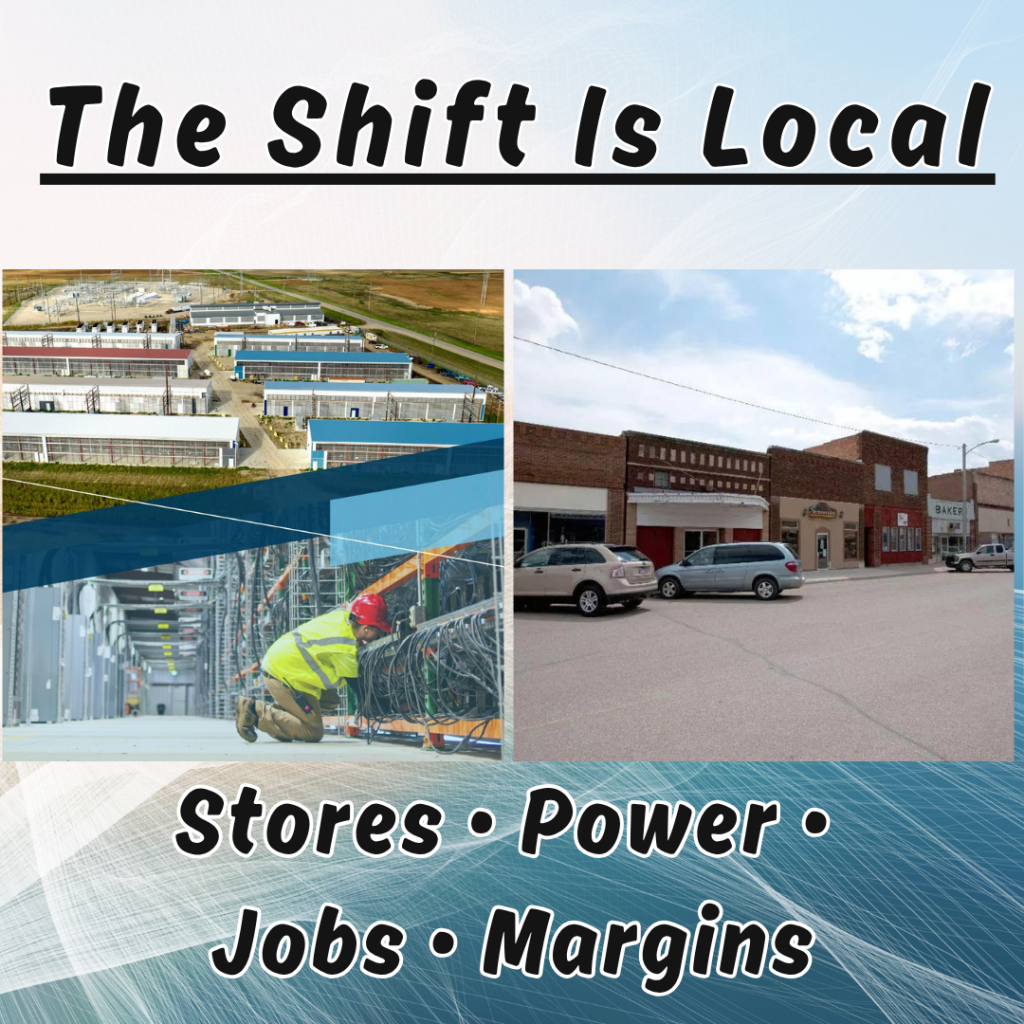
What changed • Who it affects • Why it matters
Statewide Business Pulse
▲ Moving: Rural grocery innovation, data center development, advanced materials manufacturing, targeted workforce hiring
▬ Stable: Professional services, local service businesses, community retail demand
▼ Down / Under Pressure: Hospitality margins, small-town food access, state agency capacity
Watch: Utility demand, local permitting, Main Street closures, government service speed
Today’s Signals
Rural Retail / Food Access: Rural grocers are changing the business model to stay open
What changed: Rural grocery stores are testing new survival strategies, including prepared foods, local product lines, liquor sections, shared purchasing, and distribution partnerships. North Dakota reportedly has 90 grocery stores, down from 137 in 2014, and group-buying efforts are helping some stores cut wholesale costs.
Who it affects: Rural grocers, food suppliers, cafes, local producers, small-town employers, elderly residents, and community development groups.
Why it matters: A grocery store is often more than a place to buy food. When it weakens, nearby businesses lose foot traffic, towns lose convenience, and employers have a harder time attracting workers who want basic services close to home.
Source: North Dakota Monitor — Rural grocers find creative ways to keep doors open:
https://northdakotamonitor.com/2026/05/13/rural-grocers-find-creative-ways-to-serve-customers-keep-doors-open/
Hospitality / Entertainment Districts: West Fargo tavern closure points to tighter margins
What changed: Top Shelf Tavern in West Fargo announced it will close May 30. The business opened in April 2023 and is located at The Lights along Sheyenne Street.
Who it affects: Restaurants, bars, entertainment venues, landlords, nearby retailers, event districts, workers, and suppliers.
Why it matters: Newer mixed-use districts can look busy on paper, but restaurants still need repeat customers, manageable rent, steady staffing, and enough weekday traffic to survive. This is a signal for any business counting on “location buzz” instead of repeatable customer habits.
Source: Valley News Live — West Fargo’s Top Shelf Tavern set to close May 30:
https://www.valleynewslive.com/2026/05/12/west-fargos-top-shelf-tavern-set-close-may-30/
Technology / Utilities / Land Use: Data centers are becoming a local-control business issue
What changed: North Dakota data center developers currently rely mainly on local permitting, such as township or county approval, with no single statewide review body deciding where projects go.
Who it affects: Counties, townships, utilities, contractors, electricians, landowners, farmers, economic developers, and businesses near proposed sites.
Why it matters: Data centers can bring construction work, tax base, utility investment, and service demand. They can also create questions about power use, land use, local infrastructure, and who pays for upgrades. Business owners should watch these projects before they become local flashpoints.
Source: North Dakota Monitor — Data center dilemma: Who should decide where they go in North Dakota?:
https://northdakotamonitor.com/2026/05/11/data-center-dilemma-who-should-decide-where-they-go-in-north-dakota/
Manufacturing / Defense Supply Chain: Grand Forks advanced materials work signals diversification
What changed: Vorbeck’s Grand Forks facility is tied to advanced graphene-based materials and fire suppressant production. Senator Hoeven’s office said $7 million was secured in FY2026 to support development of Vorbeck’s graphene-based fire suppressant, with the facility initially producing 1 million gallons of firefighting foam.
Who it affects: Manufacturers, defense contractors, engineers, trades, suppliers, UND-linked workforce pipelines, logistics firms, and Grand Forks-area service businesses.
Why it matters: This is not just another ribbon-cutting. It shows North Dakota’s economy pushing into advanced materials, defense supply chain work, and specialized manufacturing — industries that can create higher-skill jobs and supplier opportunities.
Source: Senator Hoeven press release — Vorbeck manufacturing facility:
https://www.hoeven.senate.gov/newsroom/press-releases/hoeven-grand-forks-high-tech-uas-ecosystem-leading-to-new-investment-tech-development-like-vorbeck-manufacturing-facility
Government Operations / Business Services: State employee buyouts could affect service speed
What changed: North Dakota’s state workforce is expected to shrink by 101 employees after a voluntary buyout program, though some positions may later be refilled. The program was created as officials prepared for tighter revenues tied partly to lower oil tax collections.
Who it affects: Businesses needing licenses, permits, inspections, agency responses, compliance help, grant administration, or state program support.
Why it matters: Even small staffing changes can show up as slower turnaround times. Business owners should build more lead time into anything involving state approvals, paperwork, program applications, or agency follow-up.
Source: North Dakota Monitor — 101 state employees take buyouts in North Dakota:
https://northdakotamonitor.com/2026/05/07/101-state-employees-take-buyouts-in-north-dakota/
Workforce / Hiring: Fair Chance Job Fairs create a targeted hiring opportunity
What changed: Job Service North Dakota lists Fair Chance Job Fairs in Bismarck, Fargo, and Grand Forks on June 4 from 11:00 a.m. to 1:30 p.m. These events are designed to connect employers with job seekers who may face barriers such as homelessness, limited education, dislocation, or a criminal background.
Who it affects: Employers needing entry-level workers, service businesses, retailers, contractors, manufacturers, nonprofits, and businesses willing to train.
Why it matters: Businesses that are short-staffed may need to widen the hiring pool. The opportunity is not just filling openings — it is building structured entry-level roles, training paths, and dependable second-chance hiring systems.
Source: Job Service North Dakota — Fair Chance Job Fair:
https://www.jobsnd.com/fairchance
Economic Development / Investment: North Dakota is courting global companies
What changed: North Dakota Commerce participated in the 2026 SelectUSA Investment Summit, connecting with global companies evaluating U.S. locations for expansion and investment. The state highlighted sectors including energy, data infrastructure, value-added agriculture, advanced manufacturing, and autonomy.
Who it affects: Economic developers, contractors, manufacturers, utilities, site selectors, engineers, landowners, logistics companies, and workforce partners.
Why it matters: These conversations may not create immediate jobs, but they show where the state is trying to compete. If even a few leads move forward, local businesses may see ripple effects in site work, housing, utility upgrades, hiring, and supplier demand.
Source: North Dakota Commerce — North Dakota connects with global companies at SelectUSA Investment Summit:
https://www.nd.gov/news/north-dakota-connects-global-companies-selectusa-investment-summit
Risk/Opportunity
Risk: Main Street businesses are facing pressure from multiple directions at once: changing customer habits, higher operating costs, staffing gaps, and slower public-sector capacity.
Opportunity: Rural groceries, advanced manufacturing, data infrastructure, and targeted hiring efforts all point to business models that reward adaptation. The businesses most likely to benefit are the ones watching early signals before they become obvious.