

*NDBU SPECIAL REPORT*
North Dakota Special Session: Four Bills Businesses Should Know About
September 1, 2026
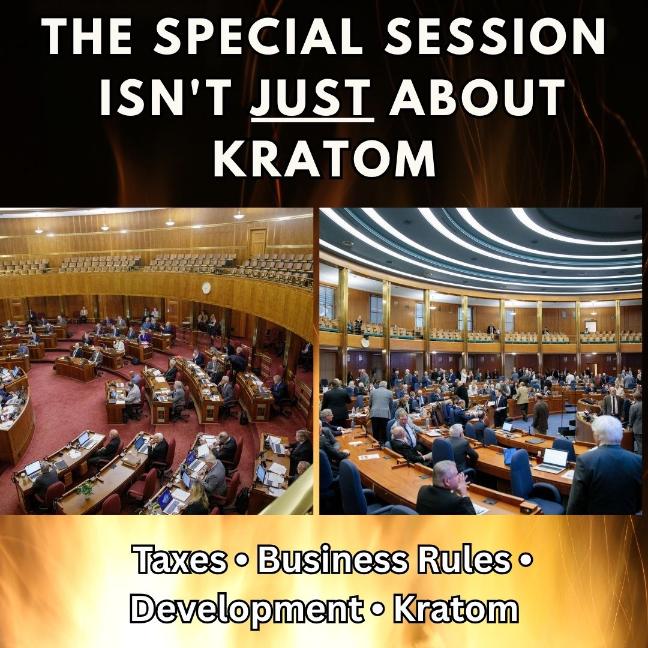
North Dakota lawmakers convene in special session September 2 following Gov. Kelly Armstrong’s August executive order concerning kratom. But the legislation now before lawmakers reaches beyond the original kratom issue.
Four introduced bills deserve particular attention from North Dakota business owners. Two would establish the state’s longer-term approach to kratom. Another changes how the primary residence property tax credit works with the early-payment discount. A fourth could affect confidentiality in negotiations between government and a broad range of private industrial developers.
Here’s what each bill would do, who could be affected, and why businesses should be watching.
HB 1628 — Kratom Would Return to the Market, Under Strict Regulation
What would change
House Bill 1628 would establish a regulated legal market for qualifying kratom products rather than continuing a blanket prohibition.
Sales would be limited to people 21 and older.
Processors and retailers could not sell products containing synthetic alkaloids, contaminated or adulterated products, products designed to resemble candy or appeal to children, or products packaged in a misleading manner.
Products would also have to carry detailed labels identifying ingredients, serving size, amounts of mitragynine and 7-hydroxymitragynine, expiration date and required health warnings. Kratom products would have to be locked behind the sales counter so customers could not access them without employee assistance.
The cost for businesses could be significant
Every processor or retailer would need a license from the Attorney General.
A separate license would be required for each location.
Initial license fee: $10,000 per location
Annual renewal: $500 per location
That distinction matters.
A small retailer with one location would face a $10,000 initial licensing expense. A company operating five locations would need five licenses, creating an initial licensing cost of $50,000 if it wanted to sell kratom at all five.
Penalties would also be substantial:
First violation: $10,000 fine + three-day license suspension
Second violation: $15,000 fine + 30-day suspension
Third violation: $25,000 fine + permanent license revocation
Noncompliant products could also be seized.
The bill provides $20,000 to the Department of Health and Human Services for a kratom public-awareness campaign.
Who should pay attention
Kratom retailers, manufacturers, processors, wholesalers and distributors would be directly affected.
That includes convenience stores, smoke and specialty shops and other retailers currently selling—or considering selling—kratom products.
Why it matters
HB 1628 would replace prohibition with a legal but highly regulated market.
For businesses, the decision would no longer simply be whether to sell kratom. Owners would have to determine whether expected sales justify the $10,000 per-location entry cost, compliance requirements and substantial penalties for violations.
The bill would also restore a legal purchasing option for adults while placing significant restrictions on the products businesses may sell and how they may sell them.
Status: Introduced. HB 1628 has a Joint Policy Committee hearing scheduled for September 2 at 10:30 a.m.
Official bill:
https://ndlegis.gov/assembly/69-2025/special-2/documents/25-1453-03000.pdf
Bill information and status:
https://ndlegis.gov/assembly/69-2025/special-2/bill-overview/bo1628.html
SB 2405 — Property Tax Discount Would Be Calculated Before the $1,600 Residence Credit
What would change
Senate Bill 2405 addresses a relatively simple question with real consequences for qualifying homeowners:
Which property tax benefit gets applied first?
North Dakota provides a 5% discount for qualifying taxpayers who pay their real estate taxes in full by the early-payment deadline.
The state also provides a primary residence property tax credit of up to $1,600.
SB 2405 would specifically require the 5% early-payment discount to be calculated before the primary residence credit is applied.
The same ordering rule would eventually apply to qualifying mobile-home taxes.
The bill does not increase the 5% discount or the $1,600 maximum residence credit.
It changes the order in which they are calculated.
Who should pay attention
This isn’t primarily a commercial-property tax bill.
Its direct benefit applies to qualifying homeowners, which includes business owners, entrepreneurs and self-employed North Dakotans who own their primary residence.
County treasurers would also have to administer the revised calculation.
Why it matters
Applying the 5% discount first can allow a qualifying homeowner to receive the benefit of that discount before the $1,600 residence credit reduces the remaining tax bill.
The legislation therefore changes how two existing benefits interact rather than creating a new tax break.
For business owners, this belongs primarily in the household side of the financial picture, rather than the operating expenses of the business itself.
Status: Introduced.
Official bill:
https://ndlegis.gov/assembly/69-2025/special-2/documents/25-1447-02000.pdf
SB 2406 — NDA Ban Could Reach Far Beyond Data Centers
What would change
Senate Bill 2406 would prohibit North Dakota state agencies and political subdivisions from entering nondisclosure agreements with developers involving proposed or operating data centers and other industrial projects.
Covered information includes:
- project location and siting;
- construction, modification and expansion;
- energy demand and type;
- water use;
- utility interconnections; and
- potential community and environmental impacts.
A developer applying for government approval would have to declare under penalty of perjury that it had not entered a prohibited NDA.
A prohibited agreement could have serious consequences.
An agency could not issue a license, permit, certification, zoning approval, tax incentive or other authorization for a project covered by an improper NDA.
Existing approvals could also be suspended, revoked or rescinded.
This isn’t only a data-center bill
That may be the most important business detail in SB 2406.
The legislation defines an “industrial project” as a project involving development of a:
business • industry • utility • infrastructure
That language is considerably broader than data centers.
Who should pay attention
Data-center developers clearly fall within the bill.
But manufacturers, energy developers, utilities, infrastructure companies, large commercial developers and other businesses negotiating projects with state or local governments should also examine the legislation.
Economic-development organizations and communities working confidentially with prospective projects may also be affected.
Why it matters
There are two interests operating at the same time.
The bill would increase the public’s ability to know about major projects being discussed with government entities, including their potential demands on power, water and community infrastructure.
At the same time, it would limit the ability of government agencies and private developers to voluntarily keep certain project negotiations confidential.
For businesses, the practical question is whether confidentiality is necessary during site selection, financing or competitive negotiations—and whether eliminating that confidentiality changes where or how companies consider investing.
The bill is temporary. If enacted, it would take effect immediately upon filing with the Secretary of State and expire June 30, 2027.
Status: Introduced.
Official bill:
https://ndlegis.gov/assembly/69-2025/special-2/documents/25-1425-02000.pdf
SB 2408 — Certain Kratom Derivatives Would Become Schedule I Controlled Substances
What would change
Senate Bill 2408 takes a different approach from HB 1628.
Rather than regulating the retail market generally, SB 2408 identifies specific synthetic or highly concentrated mitragynine derivatives and places them in Schedule I of North Dakota’s controlled-substance law.
The list includes 7-hydroxymitragynine, or 7-OH, above specified concentrations, along with mitragynine pseudoindoxyl and several other derivatives.
An important distinction for businesses:
The bill does not classify all ordinary botanical kratom as Schedule I.
For botanical material from the kratom plant, the Schedule I classification applies when the product contains more than 0.05% 7-OH by dry weight.
The legislation also specifically addresses extracts, concentrates, processed edibles and pressed pills when their 7-OH content exceeds the bill’s thresholds.
Penalties escalate for repeat offenses
Possessing or ingesting a covered mitragynine synthetic derivative would be:
First offense: Infraction
Second offense: Class A misdemeanor
Third or subsequent possession offense: Class C felony
Who should pay attention
Kratom manufacturers, processors, wholesalers and retailers would need to know exactly what is in the products they manufacture, distribute or place on their shelves.
The issue is particularly important for businesses selling concentrates, extracts, processed edibles or pressed pills.
Why it matters
HB 1628 and SB 2408 need to be read together.
HB 1628 establishes the rules for a legal kratom market.
SB 2408 establishes a line that certain derivatives and concentrations may not cross.
If both become law, a retailer could potentially operate legally under HB 1628 and still face serious problems if products in its inventory fall within the controlled-substance definitions established by SB 2408.
Product sourcing, testing and documentation therefore become business-compliance issues, not simply labeling issues.
SB 2408 would take effect immediately upon filing with the Secretary of State.
Status: Introduced. SB 2408 has a Joint Policy Committee hearing scheduled for September 2 at 10:30 a.m.
Official bill:
https://ndlegis.gov/assembly/69-2025/special-2/documents/25-1431-01000.pdf
Bill information and status:
https://ndlegis.gov/assembly/69-2025/special-2/bill-overview/bo2408.html
What Business Owners Should Watch During the Special Session
These bills have been introduced; they are not yet law. Language can change through amendments, committee action and floor votes.
For businesses, four questions are worth following:
Kratom retailers: Does the Legislature ultimately choose regulation, prohibition or some combination—and what will compliance cost per location?
Property owners: Does the Legislature preserve the proposed ordering change between the 5% early-payment discount and primary residence credit?
Developers and economic-development organizations: Does the NDA prohibition remain broad enough to cover industrial and infrastructure projects outside the data-center industry?
Retailers and processors: If kratom becomes legal under a regulated system, exactly which products remain prohibited as controlled substances?
NDBU will continue following the special session and update these explanations as legislation changes.
Plain-language business intelligence. What changed • Who it affects • Why it matters.